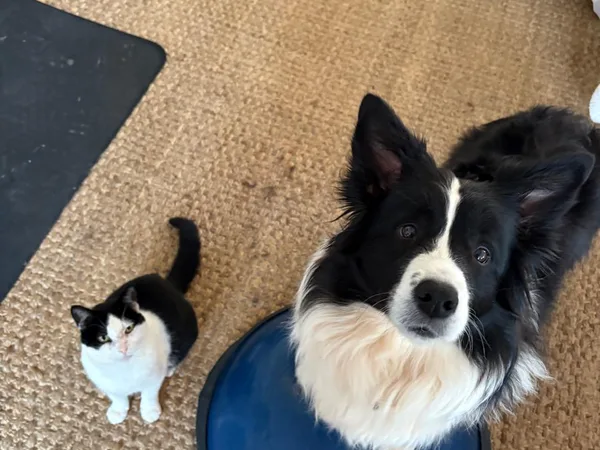
Exercise therapy is a programme of specific, controlled exercises chosen for your animal's condition, size and stage of recovery. It's the part of rehab that builds lasting strength, balance and confidence, and much of it happens at home between our visits.
What it helps with
- Rebuilding muscle after surgery or injury
- Joint range of motion and flexibility
- Balance, coordination and body awareness (proprioception)
- Core strength and posture
- Staying active with arthritis, and as animals age
- Weight management, alongside your vet's diet advice
What the research says
In a small study of dogs recovering from cruciate ligament surgery (TPLO), dogs on a physiotherapy programme had more thigh muscle at six weeks, and better knee range of motion at three and six weeks, than dogs on a walking-only plan. Lameness improved in both groups. Monk, Preston & McGowan, American Journal of Veterinary Research, 2006 (8 dogs).
“Caleigh was absolutely amazing with our Staffy after both her TPLO surgeries.”
Exercise therapy for different animals
Dogs
Controlled walking, sit-to-stands, weight shifting, balance work on cushions or boards, and walking over low poles (cavaletti) to improve gait, core strength and body awareness.
Horses
In-hand polework, groundwork for balance and topline, and controlled walking and lunging as part of a gradual return-to-work plan.
Cats
Short, gentle sessions built around play, food motivation and stretching, because cats don't do repetitions on request.
Polework for horses
Poles on the ground are one of the most useful tools in equine rehab. Stepping over them asks a horse to lift its legs, use its hindquarters and core, and think about where its feet go. Done well, polework can help with:
- Strength, particularly through the hindquarters and topline
- Balance, coordination and body awareness
- Joint flexion and range of motion
- Using both sides of the body more evenly
- Mental stimulation, especially during restricted exercise
A few principles: walk is the most useful pace, because there's no moment of suspension, so every step comes from muscular effort rather than momentum. Poles set closer together encourage shorter, more engaged steps; wider spacing encourages a longer stride. Working in-hand lets the horse move through its back, and lets you see how it's moving. Introduce polework gradually, and ideally with guidance from a physiotherapist.
What to expect
We start with an assessment of how your animal moves, then build a programme around the goals we agree. We'll show you each exercise and how to progress it, and adjust the programme at each visit. Exercise therapy works well alongside manual therapy, Electrotherapy and Kinesiotaping.
Frequently asked questions
How long are the home exercises?
Usually short. Most programmes take a few minutes a day, and we tailor them to your routine as well as your animal's condition.
Do I need special equipment?
Not usually. Many exercises use things you already have, such as cushions, poles or steps. We'll tell you if anything specific would help.
When can exercises start after surgery?
Your vet decides when it's safe to begin. We work within their post-operative instructions and progress gradually.
Where we work
We're a mobile practice, so we come to you: at home, at the yard or on the farm. We cover Betty's Bay, Botrivier, Gansbaai, Grabouw, Hermanus, Kleinmond, Pringle Bay, Somerset West, Stanford and Stellenbosch, and the areas around them. See our service area map.
This page is general information, not a diagnosis. Every animal is assessed individually, and we work alongside your vet.